

Knowledge Graph: The key to context for Enterprise AI
- Publised February, 2026
-
Duc Nguyen (Dwight)
Learn what a knowledge graph is, how it works, real enterprise use cases, benefits, architecture, and why it powers modern AI systems.
Table of Contents
Toggle
Key Takeaways
-
A knowledge graph connects data into meaningful relationships instead of isolated records
-
It enables search, analytics, and AI reasoning at enterprise scale
-
Modern AI systems rely on knowledge graphs for context, accuracy, and explainability
-
Enterprise adoption is shifting toward Hybrid Knowledge Graphs that combine vector search with structured graph logic.
Introduction
Data alone does not create intelligence. Organizations store information across CRM systems, data lakes, documents, APIs, and internal tools. Each system holds fragments of truth.
A knowledge graph unifies these fragments into a structured network of entities and relationships that machines can reason over.
What is a Knowledge Graph?
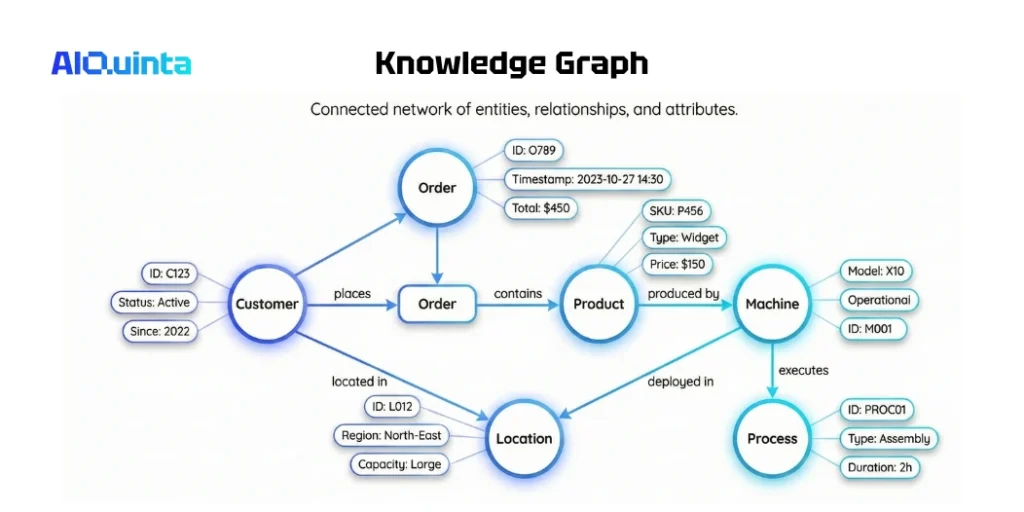
A Knowledge Graph is a structured representation of information that captures entities (nodes), their properties, and the semantic relationships (edges) between them. Unlike a flat list or a spreadsheet, it mimics human memory by organizing data as a web of interconnected concepts.
To understand, you must understand the Triple. Every fact in a graph is expressed as a “Subject-Predicate-Object” statement:
Subject: The entity (e.g., Project Phoenix)
Predicate: The relationship (e.g., is_managed_by)
Object: The target entity (e.g., Sarah Chen)
Together, millions of these triples form a “Semantic Layer” that allows computers to reason about your business data the same way an expert employee does.
Why Knowledge Graphs Are the Backbone of Enterprise AI
In the era of Agentic AI, Large Language Models (LLMs) are being asked to take actions, not just write poems. For an AI agent to be reliable, it needs more than just a “vector database“, it needs the deterministic truth of a Knowledge Graph.
Eliminating Hallucinations with GraphRAG
Standard Retrieval-Augmented Generation (RAG) uses vector similarity to find “relevant” text chunks. However, similarity doesn’t equate to fact. A Knowledge Graph provides GraphRAG, which ensures the AI retrieves not just “similar” words, but the exact, verified relationships between entities.
Disambiguation and Entity Resolution
Does “Apple” refer to the fruit, the tech giant, or a record label? A KG uses its surrounding network of nodes to provide disambiguation. If “Apple” is connected to “iPhone” and “Tim Cook,” the AI knows exactly which entity is being discussed.
Explainable AI (XAI)
When an AI makes a recommendation, stakeholders need to know why. Because a Knowledge Graph follows a logical path of edges, it can provide a “provenance trail,” showing exactly which data points led to a specific conclusion.
A Comparison with Traditional Databases
| Feature | Relational DB | Data Warehouse | Knowledge Graph |
|---|---|---|---|
|
Structure |
Tables |
Tables |
Nodes and edges |
|
Schema flexibility |
Low |
Medium |
High |
|
AI readiness |
Low |
Medium |
High |
|
Semantic reasoning |
No |
No |
Yes |
How Knowledge Graphs Work: Underlying Principles and Technologies
Knowledge graphs operate on several underlying principles and technologies.
- Ontologies and Schema: Ontologies serve as the “blueprint” or “vocabulary” of a knowledge graph. They provide a formal representation of knowledge, defining entity types, properties, and relationships. Standards like OWL (Web Ontology Language) ensure machine interpretability.
- Semantic Reasoning and Inference: Knowledge graphs use logical rules (e.g., transitivity, symmetry) to derive new, implicit facts from explicit ones.
- Query Languages: Common query languages allow users to traverse the graph and extract specific patterns or information.
- Data Integration: Knowledge graphs integrate disparate data sources by linking entities, creating a unified view over fragmented information.
Real-World Impact: Knowledge Graph Applications Across Industries
Knowledge graphs have seen widespread adoption and have had a transformative impact across various industries, especially with the rise of AI.
- Google Search and AI Overviews: Google’s shift from “strings to things” leverages knowledge graphs. This powers Knowledge Panels, Featured Snippets, and AI Overviews. The benefit is direct answers, rich contextual information, and disambiguation.
- Manufacturing – Cognitive Digital Twins and Root Cause Analysis: Integrating IoT, maintenance logs, and engineering data creates an Industrial KG. Many factories use them for RCA and cognitive digital twins for predictive maintenance. This leads to faster defect identification, smarter simulations, and operational efficiency.
- Supply Chain – Visibility and Risk Mitigation: Knowledge graphs map multi-tier relationships in complex supply networks. They are used for tracking critical minerals and predicting drug shortages. Benefits include enhanced transparency, proactive risk management, and supply chain resilience.
- Legal & Finance – Compliance and Systemic Risk: Analyzing contracts, regulations, and financial interdependencies is made easier. They check legal clauses against OWL (Web Ontology Language) and monitor systemic risk in federated banks. This ensures regulatory compliance, fraud detection, and explainable AI in high-stakes decisions.
Advanced Frontiers: Knowledge Graph Trends
The field of knowledge graphs is rapidly evolving, driven by advancements in AI and the need for robust data governance.
- Knowledge Graphs for Generative AI (GraphRAG & Neuro-Symbolic AI): Traditional Retrieval-Augmented Generation (RAG) has limitations. GraphRAG provides contextual, accurate grounding for Large Language Models (LLMs). This cures hallucinations, enables multi-hop reasoning, and increases accuracy.
- Federated Knowledge Graphs (FKGs) and Data Sovereignty: FKGs offer a decentralized approach to integrating distributed data without centralization. This ensures compliance with regulations (GDPR, EU Data Act), reduces data waste, and enhances security.
- Ensuring Data Quality – SHACL vs. ShEx: Data validation is crucial in knowledge graphs. SHACL (W3C standard, constraint-based, detailed error reporting) and ShEx (grammar-based, developer-friendly, recursive structures) offer different approaches. Choose based on needs, with a trend toward “unified” translation. This maintains data integrity, prevents “bad” data, and supports scalable data entry.
Conclusion
A knowledge graph transforms disconnected data into an intelligent enterprise memory.
It powers search, analytics, and AI agents with trusted context.
Organizations that treat knowledge graphs as strategic infrastructure gain faster decisions, stronger governance, and durable competitive advantage.
FAQs
What is a Knowledge Graph?
A Knowledge Graph is a structured representation of information that captures entities (nodes), their properties, and the semantic relationships (edges) between them. Unlike a flat list or a spreadsheet, it mimics human memory by organizing data as a web of interconnected concepts.
What are some of the key challenges in implementing a knowledge graph?
Poor Ontology Design, Data Silos Persist, Skills Gap, Performance at Scale
Is a Knowledge Graph the same as a Vector Database?
No. A vector database stores data as numerical coordinates (embeddings) to find “similarity.” A Knowledge Graph stores data as symbolic entities and relationships to find “facts.” Leading enterprises now use Hybrid Search that combines both.
Turn Enterprise Knowledge Into Autonomous AI Agents
Your Knowledge, Your Agents, Your Control
Your Knowledge, Your Agents, Your Control
Latest Articles