











 Duc Nguyen (Dwight)
Learn how ROUGE score works, calculate ROUGE-1, ROUGE-2 and ROUGE-L, interpret results, and build a reliable enterprise summary evaluation stack.
Table of Contents
Toggle ROUGE stands for Recall-Oriented Understudy for Gisting Evaluation. It was introduced as a family of automated methods for comparing computer-generated summaries with summaries written by humans.
The original framework included ROUGE-N, ROUGE-L, ROUGE-W, and ROUGE-S. ROUGE-N measures n-gram overlap, while ROUGE-L uses the longest common subsequence between two texts.
An n-gram is a sequence of adjacent words:
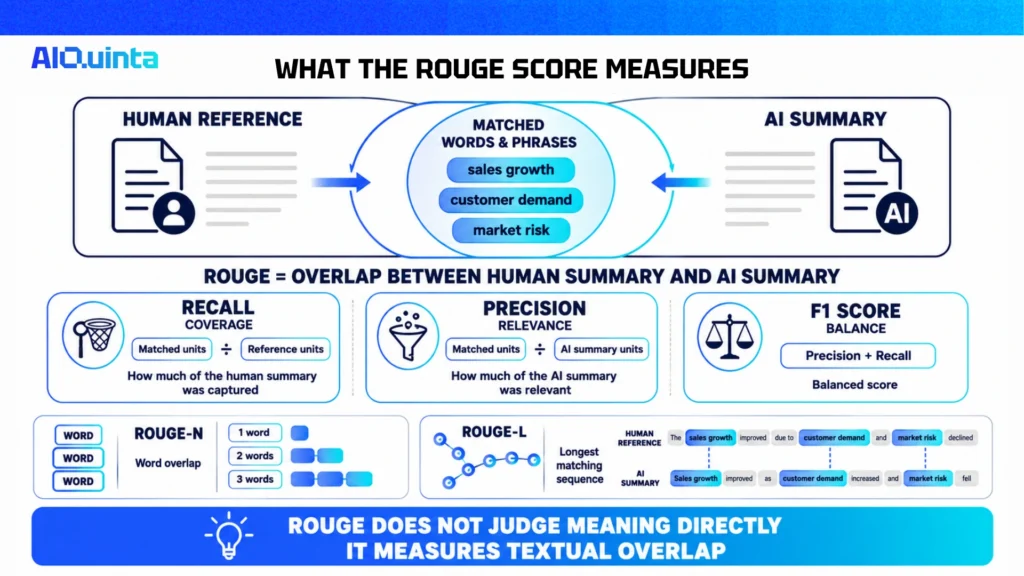
ROUGE evaluates the quality of a machine-generated summary (candidate) by comparing it to one or more human-created summaries (references). It relies on three core calculations: Recall, Precision, and the F1 Score.
To understand ROUGE, you must understand the tension between capturing enough information (Recall) and not generating irrelevant fluff (Precision).
Recall (Overlapping units ÷ units in the reference): Measures how much of the human reference summary the AI successfully captured. If the human summary has 10 key n-grams and the AI includes 6 of them, the recall is 0.6.
Precision (Overlapping units ÷ units in the generated summary): Measures how much of the AI’s generated summary was actually relevant (present in the reference). If the AI generates a 20-word summary, but only 5 words match the human reference, precision is 0.25.
F1 Score (2 × precision × recall ÷ (precision + recall)): The harmonic mean of Precision and Recall, providing a balanced single metric.
The three most reported variants test different aspects of lexical similarity.
| Metric | What it measures | What a higher score suggests | Main weakness |
|---|---|---|---|
|
ROUGE-1 |
Overlap of individual words |
Broad topic and keyword coverage |
Can reward the right words in the wrong context |
|
ROUGE-2 |
Overlap of two-word sequences |
Stronger phrase-level and local wording similarity |
Penalizes valid paraphrases more heavily |
|
ROUGE-L |
Longest ordered sequence shared by both texts |
Similar content order and sentence structure |
Still depends on exact words and may miss semantic equivalence |
ROUGE-1 is useful for testing whether a summary includes the expected people, systems, actions, risks, and topics.
For an executive meeting summary, it may detect whether terms such as “budget,” “launch delay,” “compliance review,” and “Q4” appear in both the candidate and reference.
But word presence does not prove claim accuracy. A summary containing “the launch is not delayed” may have strong overlap with a reference that states “the launch is delayed.”
ROUGE-2 requires matching pairs of adjacent words. It gives a stronger signal of phrasing and local context.
It can distinguish weak keyword collections from summaries that preserve meaningful phrases such as “renewal risk,” “customer churn,” or “production delay.”
The trade-off is lower tolerance for paraphrasing. “Operating costs declined” and “the company reduced expenditure” may communicate similar meaning but share no bigrams.
ROUGE-L finds the longest common subsequence, so matching words must remain in the same order but do not have to remain adjacent. This makes it more flexible than ROUGE-2 while retaining some sensitivity to sentence structure.
Google Research’s implementation also distinguishes rougeL, which works at text level, from rougeLsum, which treats line breaks as sentence boundaries and uses a summary-level union-LCS method. Teams must document which version they use because the values are not interchangeable.
Calculating ROUGE requires a candidate summary and a reference summary. Consider a scenario evaluating an AI’s summarization of an earnings call:
Reference Summary: “Revenue increased due to strong enterprise software sales.”
Candidate Summary: “Enterprise software sales drove a strong revenue increase.”
Step 1: Calculate ROUGE-1 (Unigrams)
The overlapping words are: revenue, strong, enterprise, software, sales. (5 words).
Reference total words: 8
Candidate total words: 8
Recall: 5 / 8 = 0.625
Precision: 5 / 8 = 0.625
F1 Score: 0.625
Step 2: Calculate ROUGE-2 (Bigrams)
Overlapping bigrams: enterprise software, software sales. (2 bigrams).
Reference total bigrams: 7
Candidate total bigrams: 7
Recall: 2 / 7 = 0.285
Precision: 2 / 7 = 0.285
F1 Score: 0.285
Interpreting the Output:
What is a “good” ROUGE score? In enterprise NLP, context dictates the benchmark. State-of-the-art models on standardized datasets (like CNN/DailyMail) typically achieve ROUGE-1 scores between 0.40 and 0.45, and ROUGE-2 scores between 0.18 and 0.22. A ROUGE-1 score of 0.80 usually indicates data leakage (the model was trained on the test set) or a purely extractive task.
There is no universal threshold.
A result can only be interpreted against a defined evaluation context:
The right benchmark is usually the current production baseline, a simple heuristic baseline, and a human-approved target set. Teams should compare systems under the same configuration and test whether observed differences remain stable across representative samples.
If ROUGE fails to capture semantic meaning, why should technical decision-makers care about it?
When structuring an enterprise AI adoption roadmap, evaluation metrics must balance accuracy with compute costs. Semantic evaluation metrics (like BERTScore or LLM-as-a-judge) require GPU inference, which is expensive and slow at scale. ROUGE relies on basic arithmetic, making it incredibly fast and virtually free to compute.
Strategic Applications for ROUGE:
Regression Testing: When fine-tuning an open-source model, you can run ROUGE across 100,000 document summaries in seconds. If ROUGE-1 drops from 0.42 to 0.25 overnight, the model is degrading. You don’t need semantic evaluation to detect catastrophic failure.
Extractive Workflows: For legal or compliance teams building an enterprise AI memory system where the requirement is to extract exact clauses verbatim rather than paraphrase them, ROUGE-L is an ideal validation metric.
Triaging Output: Use ROUGE as a first-pass filter. Summaries that score below a baseline threshold are discarded; summaries that pass the lexical threshold are then routed to a more expensive semantic evaluator (like GPT-4) for final validation.
The ROUGE score NLP metric is a foundational tool for calculating lexical overlap, but it is not a proxy for human comprehension. Structured extraction and summarization are not merely document automation tasks; they are the bedrock of enterprise decision intelligence. Relying exclusively on n-gram overlap to evaluate modern generative AI creates a false sense of security, penalizing models that synthesize well while rewarding models that parrot information without understanding it.
Strategic AI implementation requires a composite evaluation framework. Enterprises should utilize ROUGE for rapid, low-cost regression testing and exact-match validation, but must elevate their primary KPIs to include semantic similarity and human-in-the-loop assessments when integrating AI into mission-critical knowledge management pipelines.
What does a ROUGE score of 0.5 mean?
It means the candidate achieved 0.5 under a specified ROUGE variant and score type. It does not mean the summary is 50% accurate or 50% good. Interpretation depends on whether the value represents recall, precision, or F1 and whether it refers to ROUGE-1, ROUGE-2, or ROUGE-L.
Should I use ROUGE-1, ROUGE-2, or ROUGE-L?
Use all three for most summarization benchmarks. ROUGE-1 measures broad content coverage, ROUGE-2 tests phrase overlap, and ROUGE-L captures ordered sequence similarity. Their combined pattern is more informative than one value.
What is a good ROUGE score?
Benchmarks depend on the dataset. For abstractive summarization of news or reports, a ROUGE-1 score of 0.40–0.45 and a ROUGE-2 score of 0.20 are generally considered highly competitive for state-of-the-art models.