
Agentic Computation Graph (ACG): Architecture for Autonomous AI
- Publised March, 2026
-
Duc Nguyen (Dwight)
Discover what an Agentic Computation Graph (ACG) is, how it transforms static DAGs into dynamic LLM workflows, and top frameworks for enterprise AI agents.
Table of Contents
Toggle
Key Takeaways
Beyond Single Prompts: An Agentic Computation Graph (ACG) is a unifying framework that models complex Large Language Model (LLM) workflows as executable networks of nodes and edges.
Dynamic Flexibility: Unlike traditional static Directed Acyclic Graphs (DAGs), ACGs can generate new execution paths, loop continuously (cycles), and repair themselves at runtime.
Core Components: ACGs rely on Nodes (LLMs, tools, APIs), Edges (data flow, control routing), and State (shared memory) to maintain context across multi-step reasoning.
Production Reliability: Enterprise adoption favors “Micro-agents”—where deterministic code handles the routing and graph structure, and LLMs perform tightly scoped cognitive tasks.
Leading Frameworks: Tools like LangGraph, AutoGen, and LlamaIndex have made cyclic, stateful graph architectures the industry standard for autonomous agent orchestration.
The Evolution of LLM Orchestration
In the early days of Generative AI, interacting with a Large Language Model (LLM) was a linear process: a user provided a zero-shot or few-shot prompt, and the model returned a static response. Today, solving complex enterprise problems requires an architecture that can route tasks, query databases, execute code, and self-correct errors in real-time.
To bridge this gap, developers turned to workflow orchestration. However, as task complexity exploded, manually designing these workflows became a fragile and expensive bottleneck. The industry’s solution to this is the Agentic Computation Graph (ACG)—a paradigm shift that treats the workflow structure itself as a programmable, dynamic, and optimizable entity.
For AI strategists and developers looking to build production-grade agentic systems, mastering the Agentic Computation Graph is no longer optional; it is the foundational architecture of the modern AI stack.
What is an Agentic Computation Graph (ACG)?
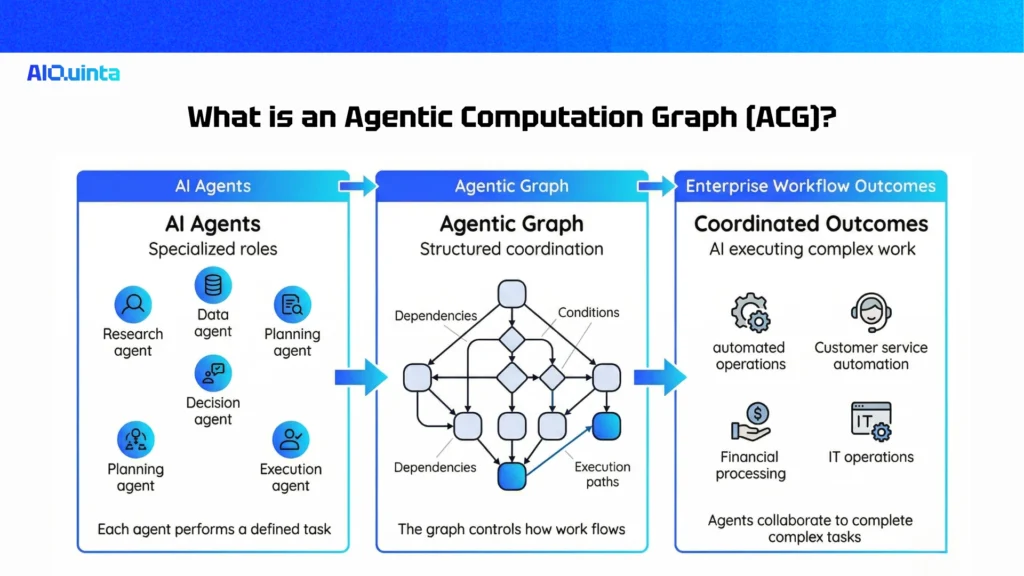
An Agentic Computation Graph is a unifying abstraction used to design, optimize, and execute LLM-centered workflows. Rather than viewing an AI agent as a monolithic black box, an ACG breaks the agent’s behavior down into a visual, topological map of dependencies and actions.
The Framework of an ACG
Recent research frameworks separate an ACG into three distinct conceptual layers to improve observability and optimization:
The Template (Reusable Scaffold): The baseline blueprint of the workflow before any user input is introduced. It defines the universe of available tools and potential pathways.
The Realized Graph (Runtime Structure): The specific topology deployed for a particular input. In static systems, this is identical to the template. In dynamic systems, it is a custom subset or a newly generated graph tailored to the user’s specific query.
The Execution Trace: The actual sequence of states, actions, latencies, and token costs recorded during the run.
The Anatomy of an ACG: Nodes, Edges, and State
To build an ACG, developers utilize three core primitives:
Nodes (The Actors): Nodes represent atomic actions within the workflow. A node could be an LLM call to extract entities, a Python execution environment, a vector database retrieval step (RAG), a schema validator, or even a human-in-the-loop approval gate.
Edges (The Logic): Edges connect the nodes and define the sequence of operations. They can represent data flow (passing the output of a retrieval node to an LLM node), control flow (conditional routing based on an LLM’s decision), or communication (message passing between two distinct AI personas in a multi-agent system).
State (The Memory): Unlike traditional stateless API calls, agentic graphs require a shared data structure. The State acts as a shared digital notebook that updates continuously as nodes execute, ensuring that downstream nodes have full context of everything that has occurred previously.
Agentic Graphs vs. Traditional DAGs: What's the Difference?
Data engineers have relied on Directed Acyclic Graphs (DAGs) in tools for years to manage data pipelines. While ACGs share conceptual DNA with data DAGs, they possess distinct capabilities engineered specifically for non-deterministic AI.
| Feature | Traditional DAG | Agentic Computation Graph (ACG) |
|---|---|---|
|
Topology |
Strictly Acyclic (No loops allowed). |
Supports Cyclic execution (loops are required for iterative reasoning and self-correction). |
|
Structure |
Static and pre-defined by a human engineer before execution. |
Dynamic. Can be pruned, generated, or edited by an LLM on the fly. |
|
Routing |
Deterministic (based on static code logic like if/else). |
Non-deterministic (semantic routing where an LLM decides the next node based on context). |
|
Failure Handling |
Fails at the node level; requires manual restart or basic retry logic. |
Employs “Verifier Nodes” that trigger dynamic replanning or automated rollback/repair sequences. |
The 3 Levels of Workflow Plasticity in LLM Agents
The true power of an Agentic Computation Graph lies in its “plasticity” – its ability to change its structure based on the complexity of the prompt. We can categorize ACGs into three distinct levels of dynamic optimization:
Selection and Pruning (The Router Model)
This is the lightest form of runtime adaptation. The system initializes with a massive “super-graph” containing every possible tool and sub-agent. When a query is received, an initial LLM router evaluates the prompt and prunes unnecessary edges, deactivating irrelevant nodes to save on token costs and reduce latency. For example, a simple greeting bypasses the database nodes entirely, while a complex financial query activates a multi-agent debate cycle.
Pre-execution Generation (Construct-then-Execute)
Common in “Plan-then-Execute” architectures, this method builds a custom DAG from scratch before any execution begins. When a user submits a multi-hop query, a Planner Agent writes a custom execution plan (often outputting a JSON or YAML graph specification). This dynamically generated graph dictates exactly which tools will run in parallel. It is highly effective for complex, multi-modal search tasks over hybrid data lakes.
In-execution Editing (Dynamic Replanning)
The most advanced, yet hardest to control, level of plasticity. In this model, the graph modifies its own topology while it is running. If an intermediate node (like a SQL generator) fails a syntax check, the ACG dynamically inserts a “repair node” to fix the query, or backtracks to a previous state to try a different approach. This requires rigorous guardrails to prevent infinite loops.
Why Enterprise AI is Shifting to Agentic Computation Graphs
Migrating from simple chains to comprehensive ACGs offers critical advantages for enterprise AI adoption:
1. Granular Observability and Auditability
When an LLM hallucinates in a black-box agent, debugging is nearly impossible. ACGs provide an explicit evidence trail. Because every step is isolated into a Node and logged in the State, engineers can trace data lineage, identify exactly which sub-query failed, and audit the reasoning process to foster user trust and meet compliance standards.
2. Latency Reduction through Parallelization
Traditional agent reasoning frameworks (like standard ReAct loops) execute tasks sequentially, creating massive latency bottlenecks. By compiling tasks into an Agentic DAG, the orchestrator can identify independent sub-tasks (e.g., fetching user data from a CRM while simultaneously querying a vector database for product docs) and execute them in parallel, drastically reducing end-to-end response times.
3. Graceful Failure Recovery
In standard RAG or basic agents, a mid-execution failure terminates the entire process. ACGs employ Verifier Nodes and cyclic loops. If an output lacks sufficient evidence, the graph intelligently loops back to the retrieval node with an amended query, rescuing partial failures without crashing the application.
Best Practices for Building Production-Ready ACGs
Designing an Agentic Computation Graph for a research paper is very different from deploying one to thousands of enterprise users. Follow these architectural best practices to ensure stability:
Embrace “Micro-Agents” and Skinny LLM Steps
Do not give a single LLM total autonomy to map and execute an entire graph. The prevailing industry consensus is that a deterministic DAG with a skinny LLM step wins in production. Use standard, deterministic Python code to handle guardrails, routing logic, retries, and API integrations. Restrict the LLM strictly to cognitive tasks: entity extraction, text synthesis, and generating the JSON payload needed to transition to the next node.
Enforce Structured Outputs
Agentic graphs rely on nodes passing data to one another seamlessly. Never rely on an LLM emitting raw markdown. Use function/tool calling or grammar-constrained decoding to force the LLM to emit strict JSON. Validate the output of every LLM node against a pre-defined schema before allowing the graph to transition to the next edge.
Implement Human-in-the-Loop Checkpoints
For high-stakes workflows (e.g., sending emails to clients, altering database records, executing financial trades), design your ACG to pause execution at critical nodes. The state should be preserved, and the graph should wait for a human operator to review the proposed action and click “Approve” before the edge allows execution to proceed.
Conclusion
The shift toward Agentic Computation Graphs represents the maturation of Generative AI. We are moving away from treating LLMs as omniscient oracles and instead treating them as highly capable reasoning engines embedded within structured, observable, and dynamic software systems.
By separating the cognitive power of the LLM from the architectural rigor of nodes, edges, and state, organizations can finally deploy autonomous workflows that are not only powerful but reliable, cost-effective, and safe for enterprise production.
FAQs
What is an Agentic Computation Graph?
It is a graph-based architecture where AI agents and tasks are represented as nodes, and dependencies between them form edges that control workflow execution.
How is it different from traditional AI pipelines?
Traditional pipelines follow a linear process. Agentic computation graphs enable parallel reasoning, multi-agent collaboration, and dynamic workflows.
What frameworks support agentic graphs?
Common frameworks include:
- LangGraph
- AutoGen
- graph-native orchestration tools for AI workflows.
Turn Enterprise Knowledge Into Autonomous AI Agents
Your Knowledge, Your Agents, Your Control
Your Knowledge, Your Agents, Your Control