


 Duc Nguyen (Dwight)
Discover how Agentic AI reshapes enterprise workflows with autonomous agents, intelligent orchestration, and real-time decision systems.
Table of Contents
Toggle Agentic AI introduces autonomous agents that plan, reason, and act across enterprise systems.
Enterprise workflows shift from rule-based automation to adaptive, goal-driven orchestration.
Success depends on data integration, governance frameworks, and human oversight.
Phased adoption with strong KPIs accelerates ROI while controlling operational risk.
Agentic AI is transforming modern enterprises by offering autonomous, goal-driven systems that leverage generative AI and Large Language Models (LLMs) to execute complex tasks with minimal human oversight. Unlike traditional AI, chatbots, or copilots, Agentic AI exhibits intentionality, adaptability, planning, and reflection, promising enhanced productivity, innovation, and strategic advantage in the “agentic enterprise“. This article explores its benefits, use cases, challenges, implementation strategies, security considerations, vendor selection, and answers frequently asked questions.
Agentic AI systems are designed to perceive their environment, reason about problems, plan multi-step solutions, and act independently to achieve specific, defined objectives. LLMs serve as the “brain” for reasoning, understanding context, and generating coherent plans. Multiple AI agents can collaborate to tackle larger, more intricate objectives.
Core Attributes:
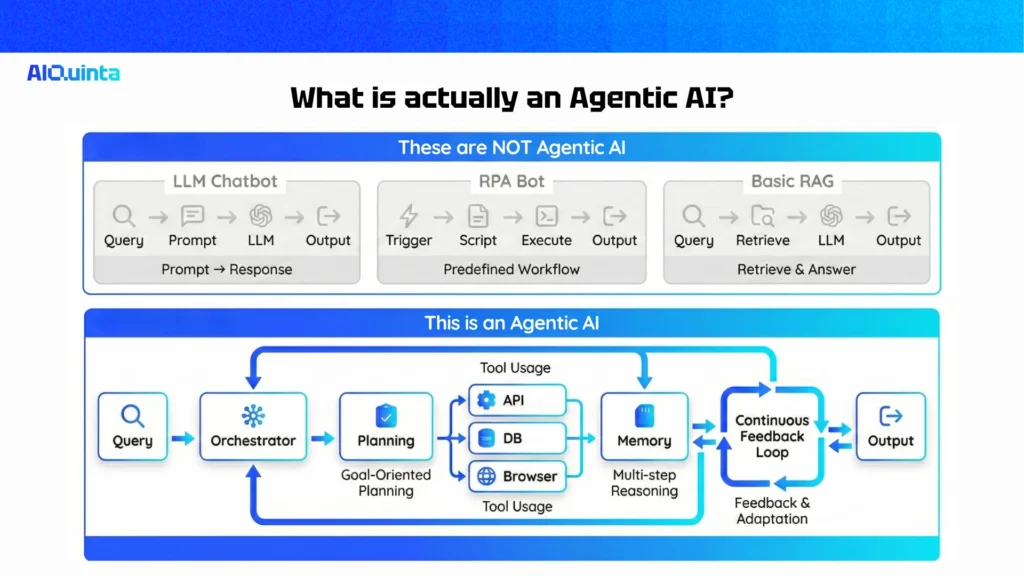
Agentic AI operates through an iterative cycle to tackle enterprise workflows autonomously.
This iterative and autonomous cycle enables agents to operate without constant human prompting.
Rising Operational Complexity
Global operations, regulatory pressure, and hybrid IT landscapes have made static automation brittle. Agentic AI addresses this by coordinating across silos and adapting to real-time signals.
Productivity and Cost Efficiency
Enterprises adopt agentic workflows to:
Reduce manual handoffs
Shrink process cycle time
Improve first-pass accuracy
Lower operational overhead
Strategic Differentiation
Organizations gain competitive advantage when workflows respond autonomously to market shifts, supply disruptions, or customer behavior rather than waiting for human intervention.
Multi-Agent Systems
Agentic platforms deploy specialized agents for:
Planning
Execution
Validation
Risk monitoring
Compliance enforcement
These agents collaborate through shared memory and orchestration layers.
Orchestration and Control Plane
A central control plane coordinates:
Task delegation
Tool invocation
Dependency resolution
Rollbacks
Human approvals
This layer ensures enterprise reliability and auditability.
Data and System Integration
High-performing agentic workflows depend on:
API-driven ERP and CRM access
Knowledge retrieval layers
Event streaming systems
Identity and access controls
Unified data contexts reduce hallucinations and enable grounded decisions.
Observability and Telemetry
Enterprise deployments embed:
Action logs
Decision traces
Outcome scoring
Policy enforcement
Observability enables compliance, debugging, and continuous improvement.
Download the Complete Enterprise Agentic AI Platform Comparison Template
This template includes a structured, enterprise-ready framework to help you evaluate and compare agentic AI vendors, covering:
Architecture, Integration & Governance: Assessment of agent intelligence, system integration, protocol support, security controls, auditability, and data provenance.
Economics & Objective Scoring: Evaluation of cost models, operational performance, ROI considerations, and a customizable weighted scoring model for side-by-side comparison.
What is agentic AI in enterprise workflows?
It’s a security principle that limits user or process access to only the permissions necessary to perform a task.
How is agentic AI different from robotic process automation?
RPA follows scripted rules; agentic AI reasons dynamically, adapts to new conditions, and orchestrates across platforms.
How should enterprises begin adopting agentic AI?
Start with focused pilots, define KPIs, embed governance early, and scale through standardized orchestration platforms.





A chatbot to answer your questions based on AIQuinta's published insights & enterprise knowledge
This is a Gen AI system. Responses are based on AIQuinta insights and should be verified.