



 Duc Nguyen (Dwight)
Discover how RISE, HCMUT and AIQuinta are driving AI innovation at the latest PTSC and New Ocean Group workshop.
Table of Contents
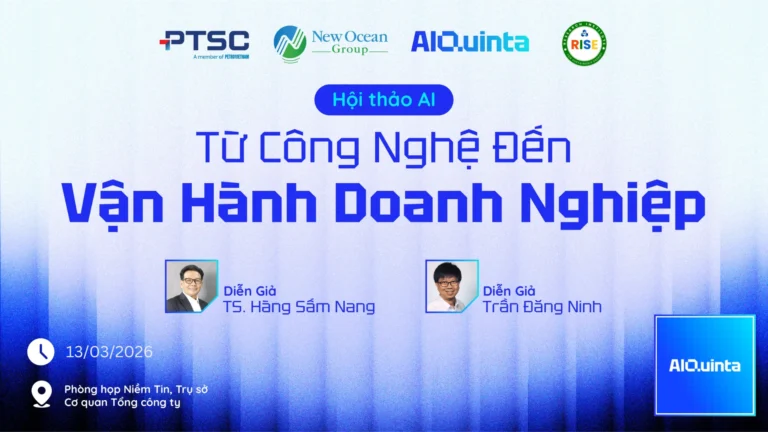
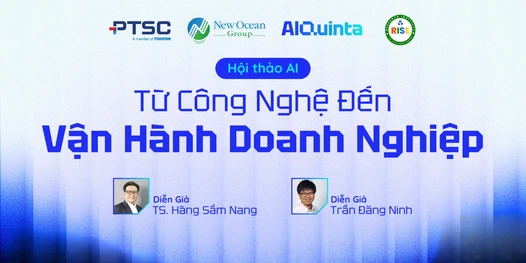
Toggle On March 13, 2025, a specialized AI workshop titled “From Technology to Enterprise Operations” was held at PTSC headquarters, organized by New Ocean Group and AIQuinta with participation from industry experts and research representatives.
The session brought together stakeholders from enterprise, academia, and technology sectors to discuss how Artificial Intelligence is evolving from a conceptual tool into a practical driver of operational efficiency.
Representatives from the Research Institute for Sustainable Energy (RISE), Ho Chi Minh City University of Technology, contributed insights into the broader AI ecosystem and its role in sustainable enterprise development.
The workshop focused on a critical question facing modern organizations:
How can AI move beyond experimentation and deliver real operational impact?
The central theme emphasized a shift in perspective.
AI is no longer positioned as an isolated innovation initiative. Instead, it is becoming deeply embedded in enterprise workflows, supporting both operational execution and strategic decision-making.
The discussion highlighted that organizations must move from:
Viewing AI as a technology investment
→ to treating AI as an operational capability
A key message reinforced throughout the session:
AI only creates value when it is directly integrated into business processes.
The workshop structured its discussion around two primary domains where AI delivers immediate value:
Back-office functions are often characterized by repetitive, manual processes. AI introduces opportunities to streamline these workflows.
Key discussion points included:
Overview of AI development and workplace applications
Enhancing productivity through intelligent automation
AI agents supporting business process execution
Enterprise use cases in management and administration
AI in this domain acts as a productivity multiplier, enabling employees to shift from manual tasks to higher-value strategic work.
For industries with complex operational systems, AI provides a more transformative impact.
The workshop highlighted applications such as:
AI-powered monitoring and operational control
Incident detection and response optimization
Process improvement in production environments
Data-driven decision-making in real time
These applications demonstrate how AI can directly influence efficiency, reliability, and cost optimization in industrial settings.
In industries such as oil and gas, contract documentation is highly complex and resource-intensive.
AI enables:
Automated comparison between contract versions
Identification of risk clauses
Faster document review processes
This reduces manual workload and minimizes the risk of human error.
Evaluating bidding documents requires high accuracy and significant effort.
AI supports this process by:
Extracting structured data from large volumes of documents
Pre-evaluating vendor capabilities
Supporting decision-making with data-driven insights
This allows teams to focus on strategic evaluation instead of manual data processing.
For asset-intensive operations, unexpected failures can result in significant financial losses.
AI enables:
Early detection of equipment anomalies
Predictive maintenance scheduling
Optimization of operational planning
This shifts organizations from reactive maintenance to a predictive, efficiency-driven model.
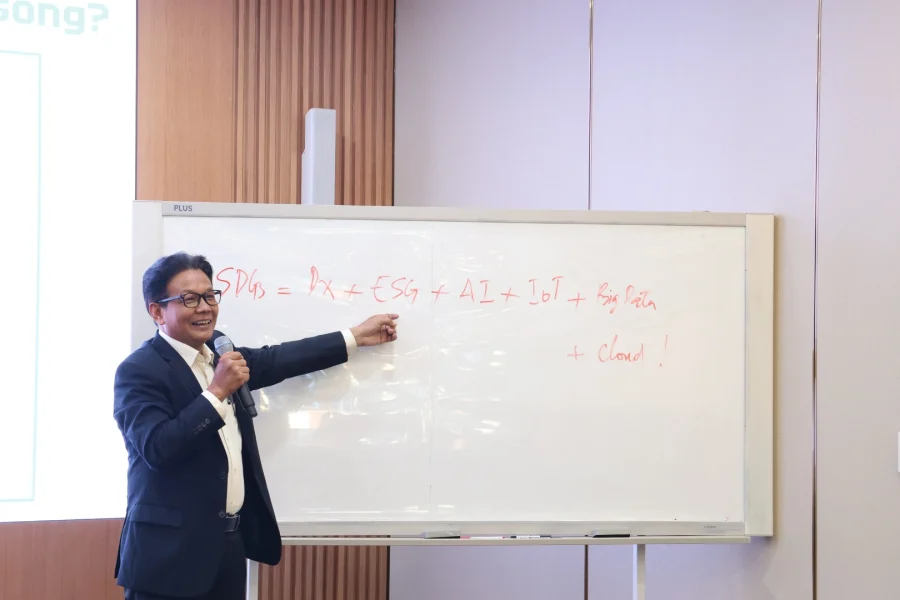
A key insight from the workshop is that AI should not be implemented in isolation.
Instead, it operates within a broader ecosystem that includes:
Digital Transformation (DX)
IoT systems for data collection
Cloud and Big Data infrastructure
ESG metrics for sustainability tracking
This integrated approach allows enterprises to move from raw data to actionable intelligence and continuous optimization.
The workshop concluded with a strong strategic message:
AI adoption is no longer optional for enterprises aiming to remain competitive.
Organizations that successfully integrate AI into their operations will:
Improve productivity
Reduce operational risks
Enhance decision-making capabilities
Achieve long-term sustainability goals
Conversely, businesses that delay adoption risk falling behind in both efficiency and innovation.
The AI workshop provided a clear and practical perspective on how Artificial Intelligence is reshaping enterprise operations.
Rather than focusing on theoretical potential, the discussion emphasized real-world applications, measurable impact, and strategic alignment.
The transition from technology to execution is already underway. Enterprises that act early and integrate AI into their operational core will be best positioned to lead in the next phase of digital transformation.


A chatbot to answer your questions based on AIQuinta's published insights & enterprise knowledge
This is a Gen AI system. Responses are based on AIQuinta insights and should be verified.