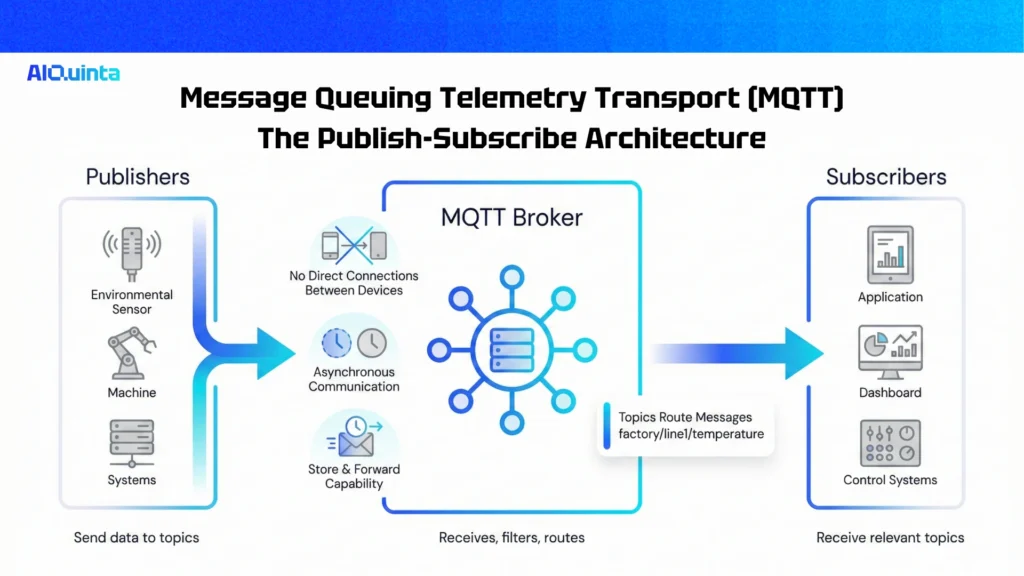
When architecting an enterprise AI or IIoT solution, choosing the right protocol dictates the scalability and resilience of your entire network. MQTT offers several unparalleled advantages:
1. Ultra-Lightweight and Bandwidth Efficient
MQTT was built to eliminate network bloat. A standard MQTT control message header is a mere 2 bytes. By minimizing the payload wrapper, MQTT allows enterprises to transmit telemetry data over expensive cellular or satellite networks without incurring massive bandwidth costs.
2. Built for Unreliable Networks
IoT sensors are frequently deployed in harsh environments with spotty connectivity. MQTT inherently supports Persistent Sessions. If a client loses its connection, the broker securely stores the client’s subscriptions and undelivered messages. Once the network is restored, the broker immediately pushes the queued data to the device, ensuring zero data loss.
3. Bidirectional Communication
While many protocols only allow data to flow from the device to the cloud, MQTT enables seamless cloud-to-device messaging. This bidirectional flow means enterprise administrators can easily push Over-The-Air (OTA) updates, configure settings, or send execution commands to millions of edge devices simultaneously.
4. Advanced Session Awareness (Last Will and Testament)
In an enterprise network, knowing when a device fails is just as important as the data it sends. MQTT includes a feature called Last Will and Testament (LWT). When a client connects, it provides the broker with a “Will” message. If the client disconnects ungracefully (e.g., power loss or network failure), the broker instantly publishes this Will message to all subscribed parties, triggering immediate maintenance alerts.