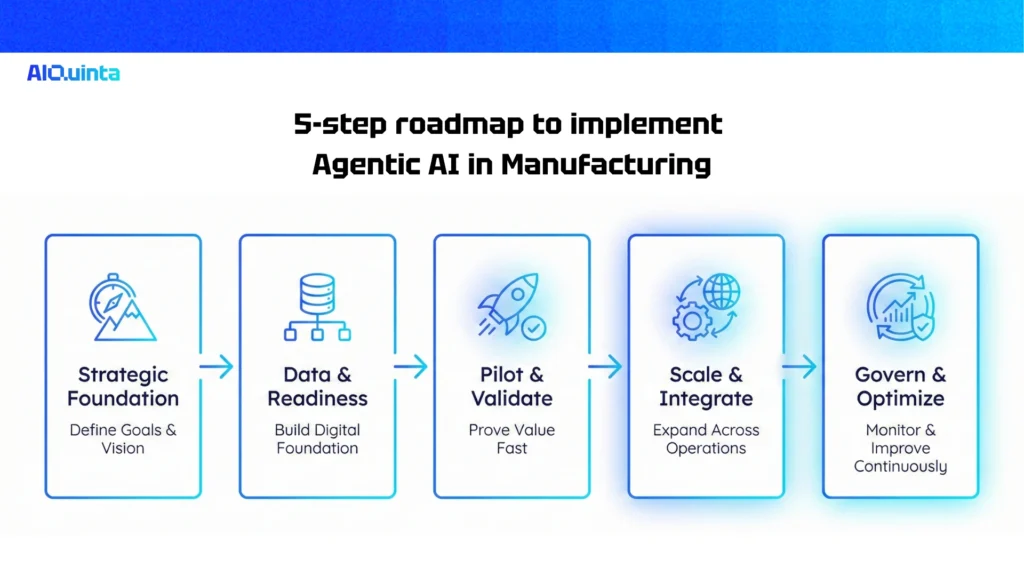


5-step roadmap to implement Agentic AI in manufacturing
- Publised February, 2026
-
Duc Nguyen (Dwight)
Discover the 5-step roadmap to implement Agentic AI in manufacturing. From strategy and data readiness to scaling across operations.
Table of Contents
Toggle
Key Takeaways
Agentic AI requires business-first strategy, not technology-first pilots.
Data readiness and OT IT integration determine early success.
Start with narrow, high ROI use cases before scaling.
Governance, security, and human oversight remain critical.
Long term value comes from orchestration across planning, production, quality, and supply chains.
Introduction
The manufacturing sector is standing at the precipice of a new era. For decades, “automation” meant pre-programmed robots repeating the same task with perfect precision. If a part arrived slightly rotated, the line stopped. If a supplier delayed a shipment, a human had to intervene.
Agentic AI changes this paradigm. It shifts the factory floor from automated to autonomous.
This guide provides a professional, step-by-step framework for manufacturing leaders to implement Agentic AI effectively, moving beyond the hype to practical, enterprise-grade deployment.
What is agentic AI in Manufacturing
Agentic AI refers to systems made of autonomous or semi autonomous agents that:
perceive plant data from sensors, MES, ERP, and quality systems
reason over goals and constraints
take actions through APIs or control layers
collaborate with other agents and humans
learn from outcomes
Unlike classic automation or dashboards, these agents execute workflows such as:
detecting anomalies and opening maintenance tickets
rescheduling production when a line goes down
sourcing alternative suppliers during shortages
guiding operators through complex repairs
Why manufacturers are moving toward Agentic AI
Manufacturers face volatility in labor, demand, energy, and compliance, making human driven coordination slower and more costly. At the same time, AI models, infrastructure, and integration tools have matured enough to support autonomous systems.
labor shortages
supply disruptions
cheaper compute
multimodal AI
Step-by-Step: Implementing Agentic AI in Manufacturing (5-step roadmap)
Phase 1: Strategic Foundation & Goal Setting
Before diving into technology, a clear strategy is crucial.
- Define clear business objectives and use cases
- Identify specific business problems or opportunities (e.g., reducing scrap, increasing throughput). Assess current processes, determine how AI enhances customer experience or decision-making. Goals should be SMART (Specific, Measurable, Achievable, Relevant, Time-bound). Prioritize based on feasibility and ROI.
- Secure executive sponsorship and build an AI roadmap
- Gain leadership buy-in for resources and organizational alignment. Develop a strategic plan outlining adoption, scaling, governance, and value extraction. Connect high-level vision to a practical implementation plan with steps, resources, risks, and KPIs.
Phase 2: Readiness Assessment & Data Strategy
AI is data-driven, so readiness is paramount.
- Evaluate data quality, accessibility, and infrastructure
- Assess the quantity, quality (accuracy, completeness, consistency, relevance), and accessibility of data. Identify structured/unstructured sources, data silos, and legacy system challenges. Agentic AI requires high volumes of quality data.
- Assess internal capabilities and address skill gaps
- Review existing workflows, technology, and team skills. Identify shortages in data science, AI engineering, and domain expertise. Plan for training and upskilling, potentially establishing a Centre of Excellence.
- Develop a robust data governance framework
- Create a comprehensive plan for data collection, storage, processing, and analysis. Implement policies for data privacy, security, and ethics. Design a data architecture that supports AI systems and IT/OT convergence.
Phase 3: Pilot Projects & Technology Selection
Starting small helps prove value and mitigate risk.
- Start with high-impact pilot projects
- Begin with small, targeted proofs of concept (PoCs) to test AI applications, gather feedback, and refine the approach. Focus on areas with clear, measurable ROI to build confidence and demonstrate value before scaling.
- Choose the right AI technology and tools
- Select AI platforms, tools, and vendors aligned with specific business needs, scalability requirements, and budget. Evaluate options: ready-made solutions vs. bespoke systems, open-source vs. commercial. Consider integration capabilities.
Phase 4: Scaling, Integration & Cultural Adoption
Expand successful pilots and ensure the organization embraces the change.
- Plan for scalability and integrate into workflows
- Design solutions for seamless expansion across the organization. Layer-by-layer integration into existing processes and IT infrastructure. Requires a robust data governance framework and an integrated data ecosystem (IT/OT convergence).
- Foster a culture of AI innovation and adoption
- Communicate the “why” – how AI augments human work, makes jobs more strategic, and enhances capabilities. Encourage experimentation, data-driven decision-making, and continuous learning. Address workforce anxiety through upskilling and clear communication.
Phase 5: Governance, Monitoring & Continuous Improvement
AI implementation is an ongoing journey requiring vigilance.
- Manage risks and build ethical frameworks
- Address ethical (bias mitigation, transparency, explainability) and regulatory (data privacy, GDPR compliance) risks. Establish strategies for human oversight and accountability for AI decisions.
- Monitor performance and measure ROI
- Define KPIs (cost savings, efficiency gains, revenue, customer satisfaction) to track AI performance. Continuously monitor models for drift, accuracy, and effectiveness. Measure both tangible and intangible benefits.
- Establish continuous learning and evolution mechanisms
- Recognize AI as a cyclical process. Implement mechanisms for ongoing model retraining, maintenance, and adaptation to new data or emerging technologies. Stay flexible and adaptable to industry changes and new AI advancements.
Overcoming challenges in Agentic AI adoption
Most competitor content underplays systemic risks that derail programs. Manufacturers should explicitly plan around these structural weaknesses.
weak data quality
poor cybersecurity
premature scaling
vendor lock in
Conclusion
Agentic AI implementation is a transformation initiative rather than a software rollout. Manufacturers that align strategy, data, people, and governance position themselves to achieve faster decisions, higher uptime, and adaptive production networks.
FAQs
How long does it take to implement Agentic AI?
Most pilots run three to six months, while enterprise programs unfold over two to three years.
Do I need to replace my existing MES or ERP to use Agentic AI?
No. Agentic AI acts as an orchestration layer on top of your existing systems. It connects to them via APIs to read data and trigger actions, actually increasing the ROI of your legacy investments.
What is the difference between a “Co-pilot” and an “Agent” in manufacturing?
A Co-pilot assists a human (e.g., summarizing a maintenance manual), whereas an Agent acts on behalf of a human (e.g., reading the manual, identifying the part number, and ordering it from the supplier autonomously).

Your Knowledge, Your Agents, Your Control