

PivotRL: High Accuracy AI Agents With 4x Less Compute
- Publised March, 2026
-
Duc Nguyen (Dwight)
Learn how NVIDIA’s PivotRL trains highly accurate AI agents 5.5x faster with 4x fewer rollout turns, balancing efficiency and out-of-domain retention.
Table of Contents
Toggle
Key Takeaways
- PivotRL is a new reinforcement learning framework designed to train AI agents more efficiently.
- It improves agentic accuracy while reducing the number of training steps required.
- The framework achieves comparable or better results with about 4× fewer rollout turns.
- PivotRL focuses on strategic decision pivots, helping AI agents recover quickly from mistakes during reasoning tasks.
- This approach reduces computational cost, speeds up training, and improves scalability for enterprise AI systems.
The Persistent AI Training Dilemma: Cost vs. Generalization
In the rapidly evolving landscape of enterprise AI, post-training Large Language Models (LLMs) to handle “long-horizon agentic tasks” is one of the industry’s most significant hurdles. These complex tasks – which include autonomous software engineering, intricate web browsing, and multi-step terminal control – require an AI to not just generate text, but to think, act, and course-correct over extended periods.
Historically, AI developers have been forced to choose between two imperfect training methodologies, facing a persistent trade-off between computational efficiency and model generalization.
Supervised Fine-Tuning (SFT): The Memorization Trap
Supervised Fine-Tuning (SFT) is computationally inexpensive and fast. However, it frequently suffers from severe Out-of-Domain (OOD) performance degradation.
The Analogy: Imagine teaching a teenager to drive by exclusively making them memorize the DMV handbook. They might pass the written test flawlessly (in-domain success), but the moment a stray dog runs into the street in the real world, they panic because that specific scenario wasn’t in the book. SFT trains models to mimic training data perfectly, but it struggles to generalize beyond its specific training distribution, often “forgetting” unrelated skills in the process.
End-to-End Reinforcement Learning (E2E RL): The Expensive Mastery
On the other end of the spectrum is End-to-End Reinforcement Learning. E2E RL typically preserves an AI’s broader capabilities while achieving incredibly high accuracy on specific tasks. The downside? It is astronomically expensive.
The Analogy: If SFT is reading the driving handbook, E2E RL is making the student drive across the entire country for every single lesson. It builds impeccable instincts and real-world readiness, but it takes an enormous amount of time, fuel, and resources. In AI terms, E2E RL requires repeated, many-turn, on-policy rollouts for every single parameter update, driving compute costs through the roof.
Introducing NVIDIA’s PivotRL: The Best of Both Worlds
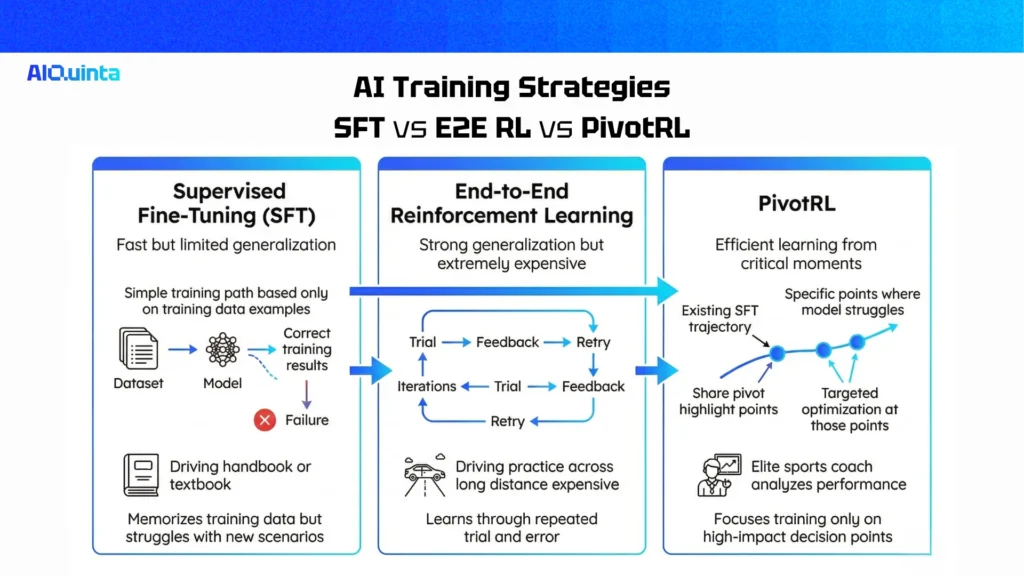
To bridge this massive gap, NVIDIA researchers have introduced PivotRL. By operating on existing SFT trajectories, PivotRL aims to deliver the deep generalization benefits of E2E RL while maintaining the data efficiency traditionally associated with SFT.
Instead of forcing the model to learn from scratch through endless trial and error, PivotRL acts like an elite sports coach. It looks at the AI’s existing baseline, identifies the specific, high-leverage moments where the AI struggles, and focuses all of its training energy entirely on those moments.
How PivotRL Works: The Architecture of Efficiency
The core philosophy of PivotRL is the transition from full-trajectory rollouts (running the whole simulation from start to finish) to highly targeted, turn-level updates. It achieves this through two primary mechanisms: Pivot Filtering and Functional Rewards.
Pivot Filtering: Finding the "Learning Sweet Spot"
In standard group-normalized reinforcement learning—specifically Group Relative Policy Optimization (GRPO) – there is a major bottleneck: uninformative turns. If an AI tries a task 10 times and succeeds all 10 times, it learns nothing new. If it fails all 10 times, it also learns nothing, because the task is simply too hard. The normalized advantage in these cases is zero, providing no meaningful gradient update.
PivotRL solves this by extracting all assistant turns from an SFT dataset into a “pivot candidate” pool. It then profiles these candidates using a frozen reference policy (π0). To optimize the training budget, PivotRL filters specifically for pivots: specific states where the AI’s outcomes show high variance.
The criteria: The turn must have a nonzero empirical reward variance and a low reward mean.
The Analogy: Think of a basketball player practicing. You don’t make them practice an uncontested layup for hours (they always make it; variance is zero). You don’t make them practice full-court backward shots (they always miss; variance is zero). You make them practice heavily defended three-pointers – shots they sometimes make and sometimes miss. By focusing exclusively on these “mixed-outcome” scenarios, PivotRL concentrates computing power on the states that provide the strongest possible learning signal.
Functional Rewards: Embracing Creative Problem Solving
Standard SFT-to-RL adaptations suffer because they rely on exact string matching. If the demonstration data says the AI must type open_browser(url="google.com"), and the AI types launch_browser("google.com"), a traditional system flags it as a failure, even though the action achieved the exact same goal.
In generative action spaces like shell commands or search queries, there are thousands of ways to be correct. PivotRL replaces strict string matching with Functional Rewards.
Using domain-specific verifiers – which can range from normalized schema checks to lightweight LLM-as-a-judge scoring – PivotRL asks one simple question: Did the action work? If the locally acceptable action achieves the goal, it is rewarded. This prevents the AI from being punished for creative, functionally equivalent problem-solving.
The Theoretical Backbone: Why PivotRL Succeeds
NVIDIA’s researchers didn’t just empirically prove PivotRL; they backed it up with rigorous theoretical foundations.
Maximizing the Learning Signal (Theorem 3.2)
Theorem 3.2 proves that the Fisher norm of the natural gradient of the statewise reward objective actually scales with the reward standard deviation. In simpler terms, the mathematical “signal” the AI uses to learn gets stronger when the variance of the outcome is higher. This mathematically validates the Pivot Filtering strategy: filtering for mixed-outcome pivots is the mathematically optimal way to maximize local in-domain learning.
Mitigating Catastrophic Forgetting (Theorem 3.3)
Theorem 3.3 demonstrates the power of minimal KL (Kullback-Leibler) change. It proves that functional reward-based RL shifts probability toward acceptable actions while preserving the reference policy’s relative probability ordering for unrelated actions.
The Analogy: Imagine learning a new language. Traditional SFT might overwrite your native vocabulary to make room for the new words (Catastrophic Forgetting). PivotRL’s architecture ensures that while you learn the new language perfectly, the neural pathways for your native language are strictly protected and left untouched.
Unprecedented Performance and Efficiency Gains
The research team put PivotRL to the test using the formidable Qwen3-30B-A3B-Thinking-2507 as the base model. They evaluated it across four rigorous agentic domains: conversational tool use ($\tau^2-Bench$), software engineering (SWE-Bench Verified), terminal control (Terminal-Bench), and web browsing (BrowseComp). The results represent a paradigm shift in AI training.
Massive In-Domain Accuracy Improvements
When compared to SFT on the exact same data, PivotRL vastly outperformed its predecessor:
Average Gain: PivotRL achieved a massive +14.11 points over the base model (compared to only +9.94 points for SFT).
Domain Specifics: PivotRL dominated across the board, beating SFT on $\tau^2-Bench$ (+5.37), Terminal-Bench (+6.25), and BrowseComp (+9.80).
Unmatched Out-of-Domain (OOD) Retention
The most glaring flaw of SFT is OOD regression. Across eight OOD benchmarks (which included unrelated tasks like math and science QA), traditional SFT caused a painful average regression of -9.83 points.
PivotRL, however, showcased ironclad stability. It maintained a near-zero average change (+0.21) on unrelated tasks. Even more remarkably, PivotRL achieved +10.04% higher OOD accuracy in non-agentic tasks compared to SFT. The AI learned complex new skills without sacrificing any of its underlying intelligence.
Turbocharged Compute Efficiency
On SWE-Bench Verified—widely considered one of the most rigorous and computationally demanding standards for long-horizon agents—PivotRL proved its economic value.
Turn Efficiency: PivotRL reached accuracy levels comparable to pure E2E RL using 4x fewer rollout turns.
Temporal Efficiency: The training wall-clock time was ~5.5x faster than E2E RL when using the exact same number of compute nodes. This efficiency has already been proven in NVIDIA’s own Nemotron-3-Super.
Value Extension: Comparing AI Training Frameworks
To visualize where PivotRL sits in the ecosystem, let’s look at a comparative breakdown of the three methodologies:
| Feature/Metric | Supervised Fine-Tuning (SFT) | End-to-End RL (E2E RL) | PivotRL |
|---|---|---|---|
|
Compute Cost |
Low |
Extremely High |
Low |
|
Training Speed |
Fast |
Very Slow |
Fast (5.5x faster than E2E) |
|
In-Domain Accuracy |
Moderate (+9.94) |
High |
High (+14.11) |
|
OOD Retention |
Poor (-9.83 regression) |
Excellent |
Excellent (+0.21 stability) |
|
Reward Mechanism |
Exact String Matching |
Environmental Reward |
Functional Rewards |
|
Rollout Turns |
None (Static) |
100% of Trajectory |
Targeted (4x fewer than E2E) |
Value Extension: Is PivotRL Right For Your Enterprise? (Checklist)
If you are an AI engineer or enterprise leader deciding how to post-train your models, use this checklist to see if PivotRL is the right framework for your use case:
Are you training for long-horizon agentic tasks? (e.g., coding, deep web research, IT automation).
Are your current models suffering from catastrophic forgetting? (e.g., they get better at coding but suddenly become worse at basic math or reasoning).
Is compute cost a limiting factor? (e.g., you cannot afford the cluster time required for full End-to-End Reinforcement Learning).
Is there more than one “right way” to solve your prompt? (e.g., utilizing shell commands or API calls where functional equivalence is more important than exact syntax).
If you checked two or more of these boxes, transitioning from standard SFT to PivotRL will likely yield significant ROI for your AI infrastructure.
Conclusion
NVIDIA’s PivotRL represents a crucial maturation in the way we post-train Large Language Models. By intelligently identifying the exact moments where an AI needs to learn (Pivot Filtering) and rewarding it for actual success rather than rote memorization (Functional Rewards), PivotRL shatters the old dichotomy. Enterprise AI providers no longer have to choose between the cheap, fragile nature of SFT and the robust, prohibitively expensive nature of E2E RL. With PivotRL, high agentic accuracy, perfect out-of-domain retention, and low compute costs can finally exist within the exact same framework.
Resources
FAQs
What exactly is a “Pivot” in PivotRL?
A “pivot” is a specific step or turn in a multi-step task where the AI’s success rate is inconsistent (high variance). Instead of wasting computing power training the AI on easy steps it always gets right, or impossible steps it always gets wrong, PivotRL focuses exclusively on these “pivots” to maximize learning efficiency.
How much faster is PivotRL compared to standard Reinforcement Learning?
In rigorous testing on the SWE-Bench Verified benchmark, PivotRL achieved accuracy comparable to End-to-End Reinforcement Learning but completed the training roughly 5.5x faster in wall-clock time, requiring 4x fewer rollout turns.
What kind of base models can PivotRL be applied to?
PivotRL is highly adaptable. In the NVIDIA research study, it was heavily tested on the Qwen3-30B-A3B-Thinking-2507 base model across domains like conversational tool use, software engineering, and web browsing. It has also been proven effective in production-grade models like NVIDIA’s Nemotron-3-Super.
Turn Enterprise Knowledge Into Autonomous AI Agents
Your Knowledge, Your Agents, Your Control
Your Knowledge, Your Agents, Your Control